

Various model sign codes and related guidance documents have been published, and many can be viewed in their entirety including the following: From The Sign Research Foundation http://www.signresearch.org/research-sign-codes/ From the USSC Foundation https://usscfoundation.org/wp-content/uploads/2018/03/USSC-Model-On-Premise-Sign-Code-2018.pdf From the Sign Research Foundation https://www.signresearch.org/wp-content/uploads/A-Framework-for-On-Premise-Sign-Regulation.pdf
Continue readingCategory Archives: Sign Codes

How Does the Americans with Disabilities Act Regulate Signage?
Undoubtedly, no aspect of any kind of signage regulations is more exacting, or likely to be altered, than those governed by the Americans with Disabilities Act (ADA), which was originally enacted in 1990. Primarily, this concerned access for people with disabilities, such as wheelchair ramps, railings, handicapped parking, etc. But it also included stipulations for […]
Continue reading
FASI Board Member Prof. Alan Weinstein Addresses APA Conference about Reed v. Gilbert
Law professor Alan Weinstein, a board member of the newly formed Foundation for the Advancement of the Sign Industry, was one of three people associated with sign-industry groups who spoke at a session on sign regulation at the American Planning Association annual conference, April 4, 2016, in Phoenix, Arizona. Speakers at the session, entitled “Regulating […]
Continue reading
What are Some Recommendations for Regulating Temporary Signage?
Writing sign codes can be challenging for city planners and administrators who have had no formal training abut the nuances of on-premise signage. But a sub-category of this task, writing regulations specifically for temporary signage, presents an even more perplexing problem. Wendy Moeller, a Cincinnati, Ohio-based planner (AICP), who recently served as president of the […]
Continue reading
Duke University Economic Professor Applies “Game Theory” to Signage
David McAdams, an economics professor at Duke University, has authored a paper entitled “The Economics of On-Premise Signs” in conjunction with the United States Sign Council. In it, he contrasts the philosophies and ramifications of sign codes in Henrietta and Brighton, New York — two communities with similar demographics, both of which are near Rochester, […]
Continue reading
How Does the Copyright Protection of the 1982 Lanham Act Affect Signs?
The Lanham Act, also known as the Trademark Act, was originally passed in 1946. It has been revised several times since then, including 1982, when it was revised by Sen. Orrin Hatch (R-UT) to prevent cities/municipalities from requiring businesses to alter federally registered trademarks. Section 1121(b) of the act states: “No state or other jurisdiction of […]
Continue reading
Is Your Sign Code Content Neutral? Reed v. Gilbert Warns it Should Be
Quite often, sign codes are primarily governed by their definitions. Many of the definitions are about types of signs: temporary, projecting, banners, fascia, freestanding, pole-mounted, etc. Quite often, however, signs are defined by their content: political, real estate, commercial, yard sale, etc. If a sign is blank, you can still tell what kind of sign it […]
Continue reading
SGIA Journal Features FASI Article on the Reed v. Gilbert Aftermath
Wade Swormstedt, the Executive Director for FASI, wrote an article for the SGIA Journal’s January/February 2017 issue entitled “Content Neutrality and Signs: The Reed v. Gilbert decision and the aftermath.” Although the actual article is only available online to subscribers, the basic copy is presented here. On June 18, 2015, the Supreme Court of the […]
Continue reading
Do Signs Economically Benefit Nonprofits?
A good wall sign appreciably helps Goodwill Industries By Richard Bass Signs have value. This has been demonstrated by such publications as “The Signage Sourcebook” http://signreference.org/the-signage-sourcebook/ and Signs of the Times magazine http://www.nxtbook.com/nxtbooks/STMG/sott, and through educational opportunities like the International Sign Assn.’s annual Signage Symposium. On-premise, or place-based, signs add value to a business and its […]
Continue reading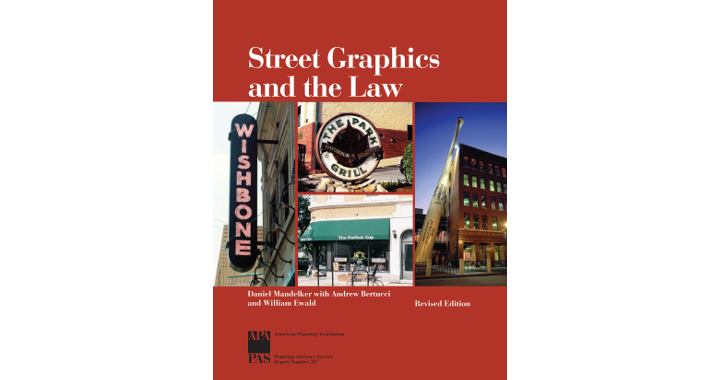
Street Graphics Continuing Tragedy
The revision’s major purpose is skirting First Amendment rights. The following article originally appeared in the January 24, 2005 issue of Signs of the Times magazine. By now, you may be sick of reading about the American Planning Assn.’s (APA) third version of Street Graphics. This will be the third consecutive month with coverage (the […]
Continue reading